
Overview of Pet Relocation to Cyprus
Relocating a pet to the Republic of Cyprus is governed by the Veterinary Services of the Ministry of Agriculture, Rural Development, and Environment. The regulations are aligned with European Union Regulation (EU) No 576/2013, which categorizes requirements based on the animal's country of origin. These rules apply to the non-commercial movement of dogs, cats, and ferrets.
Entry is strictly permitted through the designated points of entry: Larnaca International Airport and Paphos International Airport. It is important to note that pets entering via the northern part of the island (unrecognized ports or airports) are considered to be entering the Republic of Cyprus illegally and may be subject to quarantine or deportation.

Mandatory Health Requirements
To ensure biological security, all pets must meet specific health criteria before they are allowed to board a flight to Cyprus. These steps must be performed in a specific chronological order.
Identification and Microchipping
The animal must be identified by an electronic transponder (microchip) that complies with ISO Standard 11784 or 11785. The microchip must be implanted before the rabies vaccination is administered. If the chip does not meet these standards, the owner must provide their own compatible reader during inspection.
Rabies Vaccination
Animals must be vaccinated against rabies at the age of at least 12 weeks. The vaccine must be administered by an authorized veterinarian. For the primary vaccination, a waiting period of 21 days is required before the pet can enter Cyprus. Subsequent booster shots do not require a waiting period if they are administered within the validity period of the previous vaccination.

Documentation by Country of Origin
The required paperwork depends on whether the pet is arriving from an EU Member State, a listed third country, or a non-listed third country.
- EU Member States: A valid European Pet Passport is required, detailing the microchip ID and valid rabies vaccination.
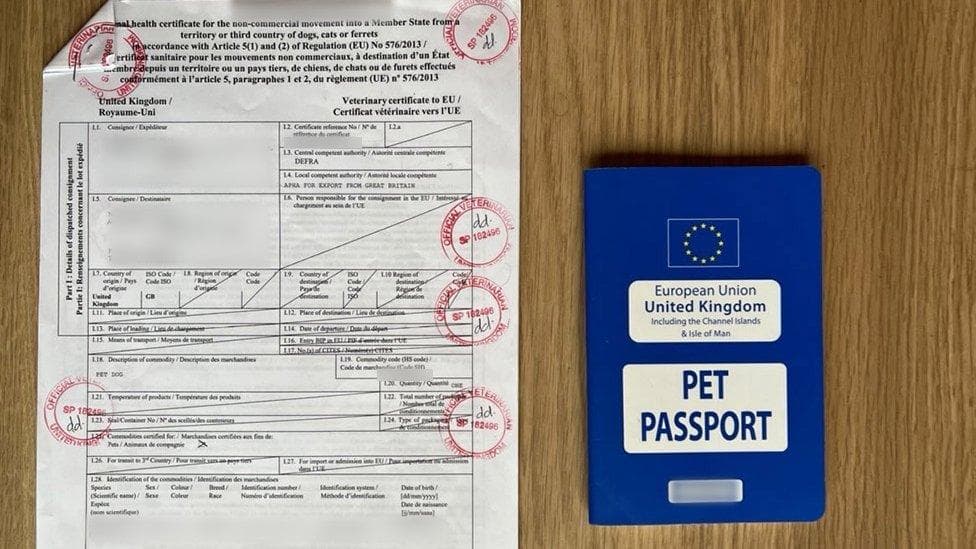
- Listed Third Countries (e.g., USA, UK, Canada): An Annex IV Animal Health Certificate is required. This document must be issued by an official veterinarian in the country of dispatch within 10 days of arrival in Cyprus.
- Non-Listed Third Countries: In addition to the health certificate, a Rabies Antibody Titre Test is mandatory. The test must be performed in an EU-approved laboratory. The sample must be taken at least 30 days after vaccination and three months before the date of travel.
Detailed information on listed and non-listed countries can be found on the Cyprus Veterinary Services official website.
Arrival Procedures and Fees
Owners are required to notify the District Veterinary Office at the point of entry at least 48 hours prior to arrival. This notification should include the flight number, date, and estimated time of arrival. Upon landing, a veterinary officer will conduct a physical inspection of the animal and a review of the documentation.
Inspection Costs
The owner or the person responsible for the pet is liable for the costs associated with the veterinary inspection. As of current regulations, the inspection fee is approximately 60 EUR ($63 USD, Jan 2026) per animal if arrival occurs during normal working hours. Additional charges may apply for inspections conducted during weekends, public holidays, or outside of standard office hours.
Note: If a pet fails the inspection due to incorrect documentation or health concerns, it may be placed in a 6-month quarantine at the owner's expense or returned to the country of origin.
Prohibited Breeds and Restrictions
Cyprus maintains strict prohibitions on certain breeds of dogs. Regardless of their country of origin or health status, the following breeds (including crosses) are not permitted to enter the Republic of Cyprus:
- American Pit Bull Terrier / Pit Bull Terrier
- Japanese Tosa / Tosa Inu
- Dogo Argentino / Argentinian Mastiff
- Fila Brasileiro / Brazilian Mastiff
Furthermore, animals must be at least 15 weeks old at the time of entry (12 weeks for vaccination plus the 21-day waiting period), as the Republic of Cyprus does not authorize the entry of unvaccinated young animals.